
Human Allogeneic iPS Cell-Derived Cardiomyocyte Patches
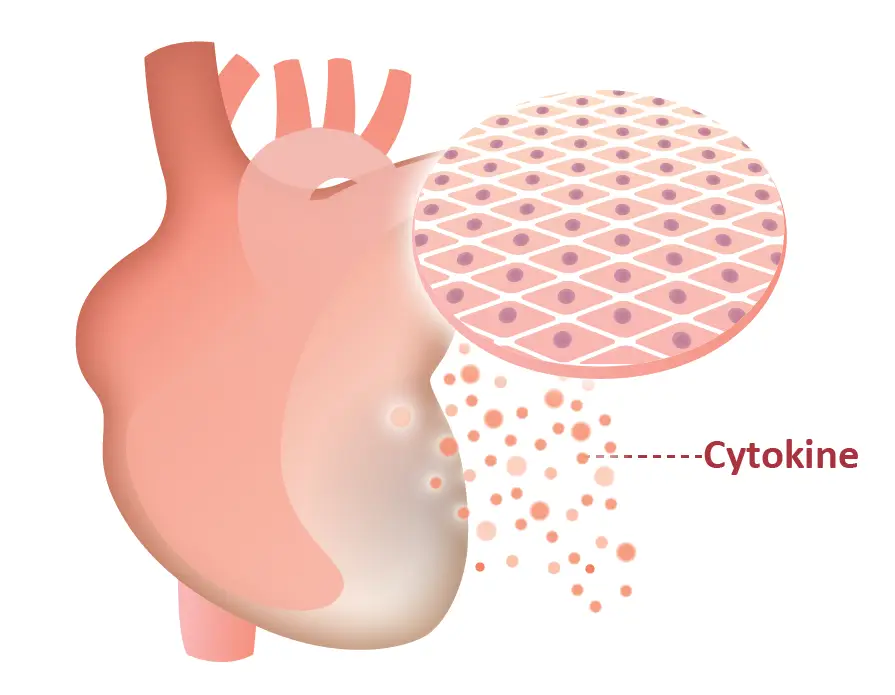
By applied directly to the surface of the heart, the product is designed to improve myocardial condition through the paracrine effects of secreted cytokines and other factors, which is expected to improve or maintain cardiac function and exercise capacity.
For more detailed information regarding RIHEART®, please refer to the official Package Insert.”⇒Lean more
Our Strength
-
01
About iPS Cells (induced Pluripotent Stem Cells) The term "iPS cells" stands for "induced pluripotent stem cells." This revolutionary name was coined by Professor Shinya Yamanaka of Kyoto University, who successfully generated them for the first time in the world and was subsequently awarded the Nobel Prize in Physiology or Medicine. iPS cells are generated by introducing multiple pluripotency-inducing factors into human somatic cells and culturing them. They possess the unique dual characteristics of near-infinite replication potential alongside the remarkable capability to differentiate into virtually any tissue or organ cell type in the human body. -
02Milestones in Research & Development
The research group led by Professor Yoshiki Sawa (currently Professor Emeritus) of the Osaka University Graduate School of Medicine—who also serves as our Director and Chief Technology Officer (CTO)—initiated a collaborative research program with Professor Shinya Yamanaka of Kyoto University in 2008, pioneering the development of therapies for severe cardiovascular diseases using human iPS cells.During this tenure, the team successfully demonstrated that human iPS cell-derived cardiomyocytes significantly improved cardiac function in porcine models of ischemic heart disease. Furthermore, they advanced the mechanistic analysis of this functional recovery, elucidating the cytokine profiles driving paracrine effects and confirming that the transplanted cells achieve electromechanical integration to beat in perfect synchrony with the recipient's myocardium.By refining the manufacturing methodologies using clinical-grade human iPS cell stocks provided by the Center for iPS Cell Research and Application (CiRA) at Kyoto University, the group successfully established a highly secure, scalable process for the mass production and sheet-formulation of these cardiomyocyte -
03Core Competencies
Mitigating Tumorigenicity Risks
While iPS cells are generally known to carry a risk of tumorigenicity (tumor formation), this is primarily driven by their inherent capacity for infinite replication. During the differentiation process into specific target cells, any failure to differentiate results in residual undifferentiated cells; the higher the number of these remaining cells, the greater the risk of tumor development.
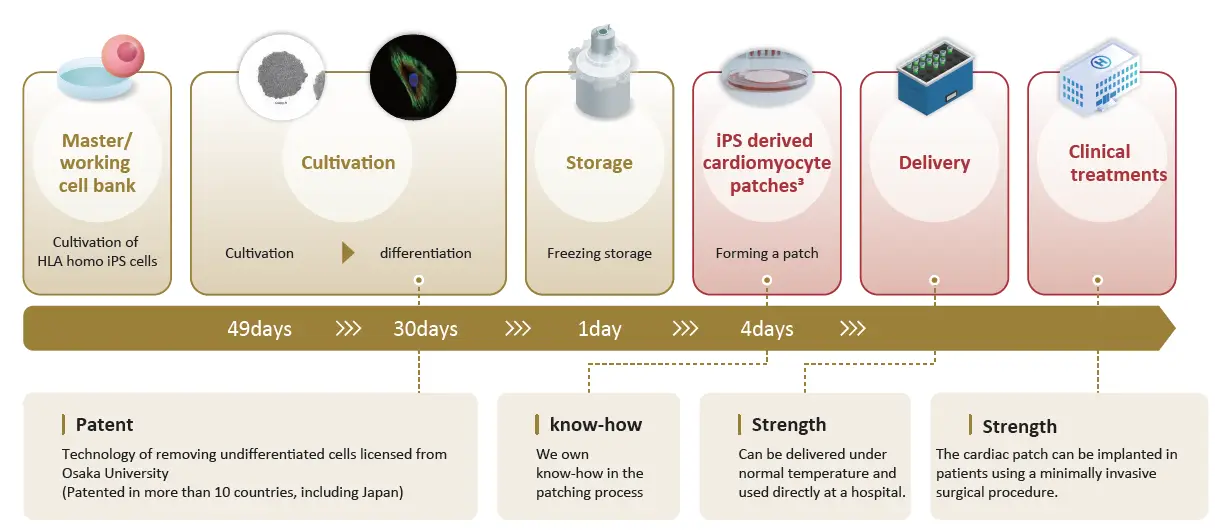
By integrating technologies from Osaka University and Daiichi Sankyo Co., Ltd., Cuorips has established a proprietary, multi-step optimized purification process. In our investigator-initiated clinical trials commenced in January 2020, no incidences of tumorigenicity have been reported to date.
Reducing Patient BurdenOur human iPS cell-derived cardiomyocyte patches are applied directly to the surface of the heart without requiring puncturing or other direct cardiac trauma. By avoiding these highly invasive procedures, this approach is engineered to minimize arrhythmogenic risks.
Furthermore, unlike conventional coronary artery bypass grafting (CABG), the surgical procedure itself does not require a full median sternotomy. Instead, it is performed via a left minithoracotomy with a relatively small incision of approximately 7 cm, through which the patches are inserted. While typical bypass surgeries can require around 4 hours, this innovative procedure can be completed in approximately 50 minutes. This significant reduction in surgical time is expected to keep patient invasiveness to an absolute minimum while substantially alleviating the physical and mental burden on the operating surgeon.
Reducing Healthcare Institutions BurdenRather than employing conventional cryogenic transport, our proprietary technology enables the transport of fully thawed and cultured human iPS cell-derived cardiomyocyte patches at ambient temperatures, while maintaining high cellular viability over extended periods. For example, product manufactured at our commercial cell culture and processing facility, CLiC-1 in Minoh, Osaka, can be seamlessly transported to medical institutions in Tokyo via the Shinkansen (bullet train). Furthermore, we hold proprietary technologies in the specialized preservation media designed to protect the structural integrity of the patches during transit, ensuring they remain viable and functionally intact for approximately 48 hours at room temperature. This robust logistics capability guarantees reliable delivery to medical centers across Japan.
Critically, because our patches are delivered in a pre-formulated, non-frozen state, receiving hospitals do not require complex thawing or specialized processing equipment; the surgical team simply performs a brief rinse before immediate transplantation. This 'ready-to-use' clinical workflow establishes a profound competitive differentiation, drastically reducing the operational burden on healthcare institutions.
- Manufacturing ProcessThrough collaborative research and development with academia, we possess core competencies in the essential technologies required for the development and commercialization of human iPS cell-derived cardiomyocyte products, specifically:
- Stable, undifferentiated passage culture of human iPS cells
- Directed differentiation and generation of specialized cells (specifically cardiomyocytes) from human iPS cells
- High-purity purification of human iPS cell-derived cardiomyocytes and the thorough elimination of undifferentiated cells
- Advanced analytics and characterization assay methodologies for human iPS cells and differentiated cells